Ecker Fellows Program
The BPSI Ecker Fellows Program
Psychoanalysis and the Creative Arts
Director: Diane O’Donoghue, PhD - Chair, BPSI Division of Interdisciplinary Psychoanalysis
In the Spring of 2022, the New England Foundation for Psychoanalysis awarded the Boston Psychoanalytic Society and Institute a grant to establish a program in Interdisciplinary Psychoanalysis, to bring creative artists to BPSI to engage with psychoanalysis.
Called the “Ecker Fellows Program“, this yearly initiative will involve a small cohort of distinguished early-to-mid career professionals in the performing arts, who will be offered an opportunity for sustained study of psychoanalytic principles in order to deepen and enrich their creative endeavors. This will occur within a program of study tailored to each artist’s interests.
The Fellows’ year is an immersive experience in psychoanalytic ideas and engagement within the BPSI community. Fellows are invited to develop an individualized program of study with their mentors, who are BPSI members selected for their commitment and knowledge of the arts, ability to complement the Fellows’ interests, and their capacity to enrich and deepen an interdisciplinary dialogue.
The areas of interest shared between psychoanalysis and the arts are rich and vast. It is our hope that the linkages the Ecker Fellows forge at BPSI will continue in several sites: amongst themselves, with the psychoanalysts with whom they share their year, and within their respective arts communities. The Ecker Fellows Program aims to develop into an established locus of interchange between psychoanalysis and the arts, for the benefit of both of these disciplines, as well as the larger community and ultimately to strengthen connections to broader public engagements.
Meet The FellowsPaul G. Ecker, MD
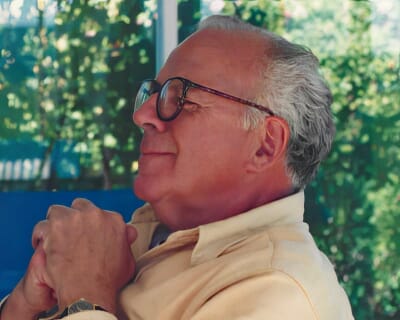
Paul Gerard Ecker, MD (1919–2002) was a remarkable man whose boundless curiosity and passion for learning spanned the spectrum of disciplines from the sciences to the arts. In addition to his intellectual talents and accomplishments, his greatest attributes were those one would recognize only in his company – his remarkable gentility, kindness, insight and patience in the care of his patients and his relationships with friends and family.
Born in Cleveland Ohio, he graduated from Case Western Reserve Medical School in 1944. He joined the Navy as one of the earliest Flight Surgeons and pioneered aviation medicine. After the war, he taught at The Peter Bent Brigham Hospital in Boston and the Columbia Presbyterian Hospital in New York before completing his psychoanalytic training at the New York Psychoanalytic Institute in 1950. In that same year he married Henriette Juliette Dumas from St Jean, Quebec. They had two sons, Hendrik Michel (1952) and Christian Paul (1955). While in New York, he was a Fellow at the Rockefeller Institute where he designed a device to cool ultracentrifuges with liquid nitrogen.
During the Korean War he was called to serve as a Flight Surgeon and researcher outside Philadelphia where the Johnsville Naval Air Station housed the largest human centrifuge in existence. Virtually all the Mercury and Gemini astronaut candidates underwent centrifuge testing at Johnsville. He became an Associate Professor of Psychiatry at the University of Pennsylvania and a Teaching Analyst at the Philadelphia Institute for Psychoanalysis, serving a term as President. A voracious reader who studied church history, philosophy and neurosciences, he spoke three languages and could read Latin. He had a lifelong passion for art, cultivating relationships within the art world and becoming an accomplished collector of Chinese ceramics and Gothic art.